










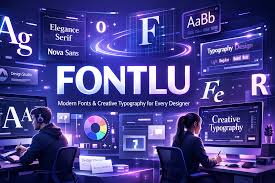
In the modern digital economy, first impressions are formed in seconds—and often, those impressions are not shaped by what a brand says, but by how it looks. Typography, in particular, has become one of the most powerful yet underestimated tools in digital communication. Within this evolving landscape, fontlu is emerging as a concept tied to the next generation of design thinking, where fonts are no longer just aesthetic choices but strategic elements of brand identity and user experience.
For startup founders, entrepreneurs, and technology professionals, fontlu represents a deeper shift in how digital products are designed and experienced. It reflects a world where typography is not treated as decoration, but as infrastructure—something that directly influences readability, trust, engagement, and conversion.
In a marketplace where attention is scarce and competition is global, even small design decisions can have massive business impact. Fontlu captures this reality and places typography at the center of modern digital strategy.
Understanding the Concept Behind Fontlu
Fontlu can be understood as a modern approach to typography systems designed for digital-first environments. Instead of selecting fonts purely for visual appeal, the concept emphasizes the strategic use of typography to improve communication, accessibility, and brand identity.
In traditional design workflows, typography was often chosen at the final stage of development. It was treated as a finishing layer applied after structure and content were already defined. This approach is no longer sufficient in a world where user experience is shaped from the very first interaction.
Fontlu represents a shift in mindset.
Typography is no longer an afterthought. It is part of the foundation.
Modern businesses increasingly recognize that fonts influence how users feel about a product before they even begin interacting with it. A clean, well-structured type system can communicate professionalism and trust. A poorly chosen font can do the opposite, even if the product itself is strong.
Fontlu brings attention to this subtle but powerful layer of digital communication.
Why Fontlu Matters in the Digital Economy
In today’s digital economy, competition is not limited to features or pricing. It extends into perception, usability, and emotional response.
Typography plays a direct role in all three.
Fontlu matters because it highlights typography as a core component of user experience design rather than a purely visual detail. Every letter a user reads contributes to how they interpret a product, brand, or platform.
For example, fintech platforms often use clean, structured typography to communicate security and reliability. Creative startups may use more expressive typography to reflect innovation and originality.
These decisions are not accidental. They are strategic.
As businesses move into increasingly saturated digital markets, the ability to differentiate through design becomes critical. Fontlu reflects this shift toward typography-driven branding strategies.
The Evolution of Typography in Modern Design Systems
Typography has evolved significantly over the past decade, driven by changes in technology, user behavior, and design philosophy.
In early digital environments, designers were limited to a small set of web-safe fonts. Consistency and functionality were more important than expression.
Today, design systems are far more flexible. Web technologies, responsive design frameworks, and advanced rendering engines allow for complex typography systems that adapt across devices and platforms.
Fontlu reflects this evolution by treating typography as a dynamic system rather than a static choice.
Modern typography systems now consider:
- Screen adaptability
- Accessibility standards
- Brand consistency across platforms
- Emotional tone of communication
- Performance optimization
This shift has transformed typography into a discipline that sits at the intersection of design, technology, and psychology.
Fontlu and User Experience Strategy
User experience is one of the most important factors in digital product success. While navigation, layout, and functionality are often prioritized, typography quietly influences how users process and engage with content.
Fontlu emphasizes typography as a functional element of UX design.
Readable, well-structured text reduces cognitive load. It allows users to understand content quickly without friction. Poor typography increases effort, leading to frustration and abandonment.
In many cases, users do not consciously notice typography—but they always feel its impact.
A strong typography system improves:
- Reading speed
- Information clarity
- Emotional comfort
- Navigation efficiency
- Overall engagement
For startups building digital products, this can directly influence retention and conversion rates.
Comparative View of Typography Approaches
To understand the practical impact of fontlu, it helps to compare traditional typography approaches with modern system-based thinking.
| Traditional Typography Approach | Fontlu-Oriented Typography Approach |
|---|---|
| Fonts chosen for aesthetics only | Fonts chosen for function and branding |
| Limited consistency across platforms | Unified cross-platform typography system |
| Static design implementation | Responsive and adaptive typography |
| Late-stage design decision | Core part of product architecture |
| Focus on visual appeal | Focus on usability and communication |
| Minimal accessibility consideration | Accessibility-first design approach |
This comparison shows how typography has moved from decoration to strategy.
Fontlu in Branding and Digital Identity
Brand identity in the digital age is heavily influenced by visual consistency. Typography is one of the strongest contributors to that consistency.
Fontlu reflects the idea that typography is not just part of branding—it is branding.
When users interact with a brand across websites, mobile apps, presentations, and social platforms, typography becomes a unifying element that reinforces recognition.
Consistent typography builds:
- Trust through familiarity
- Recognition across platforms
- Emotional connection with users
- Professional credibility
For startups, this is especially important. Before a brand becomes widely known, its design language often carries the responsibility of establishing trust.
Typography is one of the fastest ways to communicate maturity and reliability.
The Psychology Behind Fontlu and Typography Choice
Typography influences human perception in subtle but powerful ways. Different font styles can evoke different emotional responses.
Fontlu takes into account this psychological dimension of design.
For instance:
- Serif fonts often feel traditional and trustworthy
- Sans-serif fonts feel modern and clean
- Bold fonts communicate strength and urgency
- Light fonts suggest elegance and minimalism
These associations affect how users interpret content, even if they are not consciously aware of it.
In digital products, where decisions are made quickly, these psychological signals become especially important.
Typography becomes part of the emotional design system.
Challenges in Implementing Fontlu Principles
Despite its advantages, implementing structured typography systems is not always simple.
One major challenge is consistency across platforms. Different devices and operating systems render fonts differently, which can affect visual accuracy.
Another challenge is scalability. As products grow, maintaining a unified typography system across multiple teams and products becomes more complex.
Design teams also face decision fatigue. With so many font options available, choosing a system that balances aesthetics, performance, and accessibility requires careful planning.
There is also the risk of over-designing typography systems to the point where they become rigid and difficult to adapt.
Successful implementation requires balance between structure and flexibility.
The Role of Technology in Fontlu Systems
Modern typography systems are increasingly supported by advanced technologies.
Web font optimization, variable fonts, and responsive design frameworks allow typography to adapt dynamically based on screen size, resolution, and context.
Fontlu aligns closely with these technological developments.
For example, variable fonts allow a single font file to behave like multiple styles, improving performance while maintaining design flexibility.
Design systems also integrate typography rules directly into codebases, ensuring consistency across development teams.
This integration between design and engineering is becoming a standard practice in modern digital product development.
Fontlu and the Future of Digital Communication
The future of digital communication will likely be shaped by more adaptive and intelligent design systems.
Typography will not remain static. It will evolve based on user behavior, device context, and environmental conditions.
Fontlu represents the early stages of this transformation, where typography becomes more responsive, personalized, and system-driven.
In the future, we may see:
- Fonts that adapt to reading speed
- Typography that adjusts based on accessibility needs
- Dynamic type systems powered by AI
- Fully responsive brand identity systems
These innovations will further strengthen the role of typography in digital communication.
The Human Side of Fontlu
Despite its technical foundations, fontlu is ultimately about human experience.
Typography affects how people read, understand, and feel about information. It shapes clarity, reduces friction, and improves comprehension.
Good typography does not draw attention to itself. It quietly improves the experience.
Fontlu emphasizes this principle: design should support communication, not compete with it.
In this sense, typography becomes a bridge between technology and human understanding.
Conclusion
Fontlu represents a modern shift in how typography is understood and applied in digital environments. It moves typography from a decorative element to a strategic system that influences usability, branding, and communication.
In a world where digital experiences define business success, typography plays a far more important role than many realize. It affects how users perceive trust, clarity, and professionalism from the very first interaction.
For startups, entrepreneurs, and technology professionals, adopting fontlu-inspired thinking means treating typography as part of the core product strategy—not just the visual layer.
As digital systems continue to evolve, typography will become even more dynamic, adaptive, and intelligent. Businesses that understand and implement these principles early will be better positioned to build stronger, more effective digital identities.
Fontlu is not just about fonts. It is about how we communicate in a digital-first world.